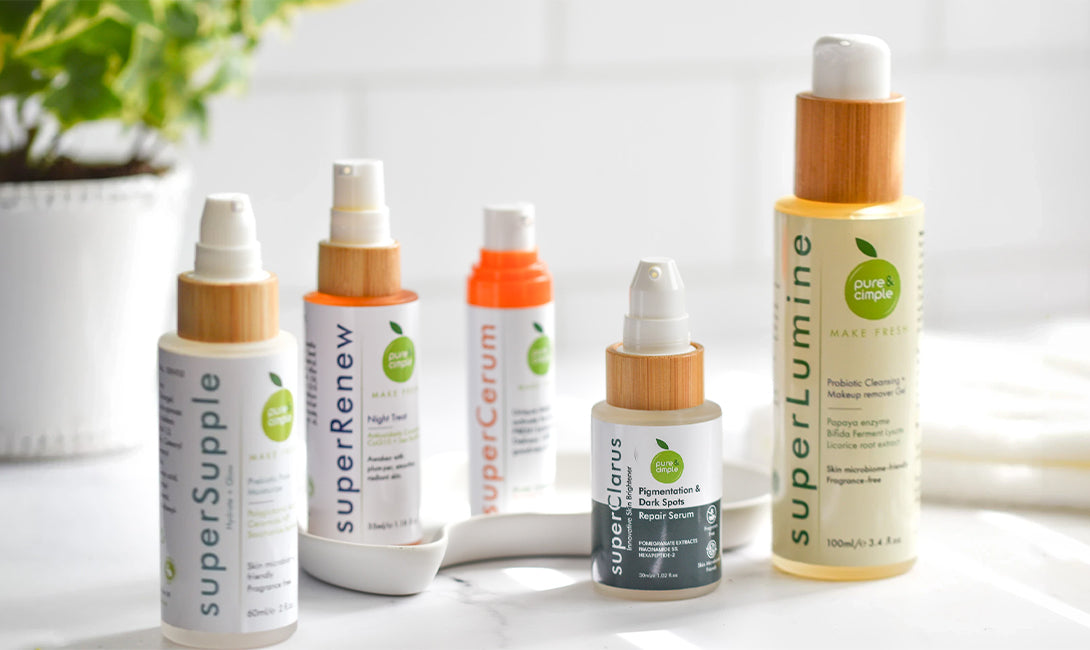















Real Results, Real Glow


Morning & Evening 3-Step Rituals
Morning & Evening 3-Step Rituals
Hurry up, only 5 items left in stock.
Over 1,000 Positive Reviews

Liz T.
I've been using the superSuple Moisturizer for a few weeks now, and I can honestly say it's a game-changer for my skincare routine! The texture is rich but not greasy, and it absorbs beautifully into the skin. My face feels hydrated all day without that heavy or sticky feeling that some moisturizers leave behind.


Michael
superClarus has truly transformed my skin! The serum's non-greasy texture absorbs effortlessly into the skin, leaving it hydrated and refreshed. With consistent use, my complexion has noticeably brightened, and dark spots are fading.


Jessica G.
This probiotic cleanser is a game changer! I am very aware of the ingredients that are in the products I’m using on my skin and this cleanser is magic. I was searching the market for a cleanser to add into my routine that would help nourish my skin and remove makeup.


Francine T.
This lightweight formula hydrates the skin without clogging pores. It's appropriate for all skin types, including delicate or highly sensitive skin. The formula is free from fragrance and essential oils, which makes it gentle and non-irritating. It's also sustainable, organic, vegan, eco-friendly, safe, and kind to both your skin and the planet.

Create Your Skincare Ritual


Skincare Journal

Retinol Purge vs Barrier Damage: How to Tell the Difference + 7-Day Rescue Plan
If retinol made your skin “worse,” you’re not alone. And you’re not “bad at skincare” for reacting. Here’s the truth I wish more people heard: most “retinol purges” are actually irritation or barrier stress… and you can usually tell by looking at just two things: Your cleanser (is it stripping?) Your moisturiser (is it actually barrier-supportive?) This guide will help you: Tell purge vs barrier damage in under 2 minutes How to choose your cleanser & moisturizer to reduce retinol purge Reset your skin with a 7-day rescue plan Restart retinol safely, without repeating the same cycle FAQs Purge or Barrier Damage? (2-minute checklist) More likely a purge if: Breakouts look like small pimples/whiteheads (not rashy) They’re in your normal acne areas (chin/jaw/T-zone) Skin feels mostly normal otherwise (minimal sting/burn) It started within ~1–3 weeks of starting or increasing retinol Each blemish clears in a “normal acne” timeline More likely barrier damage/irritation if: Your moisturizer (or even water) stings You feel burning, heat, tightness You have red patches, rawness, or “sandpapery” texture You’re flaking in a way that feels painful, not just dry It’s happening in new areas (cheeks, around nose/mouth/eyes) Suddenly everything feels sensitizing You’re breaking out and your skin feels inflamed/itchy Biggest tell: Purging is about clogs surfacing. Barrier damage is your skin saying: too much, too fast. How to choose your cleanser + moisturizer to reduce retinol purge Retinol overdrives skin renewal but it also makes skin more prone to dryness and sensitivity while you’re adjusting. That’s why the “retinol problem” is often aggravated by the "routine problem" a cleanser that strips + retinol dryness = raw barrier a moisturizer that isn’t barrier-supportive + retinol = tight skin that never stabilizes So if you want retinol to work long-term, the key isn’t adding more steps. It’s choosing the right cleanser and the right moisturizer. The sneaky culprit: foaming cleansers A lot of retinol reactions are made worse by cleansing. Foaming cleansers can become the tipping point during retinol adjustment: surfactants + hot water + retinol dryness = tight, squeaky, reactive skin and reactive skin makes everything sting (even “gentle” products) What works while adjusting to retinol Non-foaming, creamy cleansers (low-lather, gentle) Cleansing oils or cleansing balms (especially at night for sunscreen/makeup) Short cleansing (20–30 seconds), lukewarm water Simple rule: If your face feels tight right after cleansing, it’s too stripping for your current barrier. The other half: your moisturizer should “build,” not just “coat” When skin is irritated, a heavy cream can feel good temporarily - but long-term stability usually comes from a moisturizer that supports the barrier’s structure. A helpful blueprint for a barrier-supportive moisturizer Look for the “Barrier Trio”: Ceramides + Cholesterol + Fatty Acids (aka “triple lipids”) And for comfort/steady hydration: Panthenol (comfort support) Ectoin (calm support for “overstimulated” skin) PGA (Polyglutamic Acid) (cushiony hydration) Saccharide Isomerate (long-wear hydration; helps “dry again in 2 hours” skin) (This is the formulation logic behind superSupple—triple lipids + comfort + long-wear hydration—but you can use this checklist to evaluate any moisturizer.) The 7-Day Rescue Plan (Cleanser + Moisturizer Focus) Goal for 7 days: calm the skin + stop the cycle. This is intentionally boring. Boring is how you win. The rescue rules (all 7 days) Stop retinol (and all exfoliating acids) No scrubs, no brushes, no peels Avoid hot water / long showers on the face Keep routines short: cleanser → moisturizer → sunscreen (AM) Day-by-day (simple and realistic) Days 1–2: Stop the fire AM Rinse (or gentle non-foaming cleanse if needed) Barrier-supportive moisturizer Sunscreen PM If wearing sunscreen/makeup: cleansing balm/oil Barrier-supportive moisturizer - apply while skin is slightly damp unless dampness stings (then apply to dry skin) If you’re very tight: add a second thin layer of moisturizer 5–10 minutes later. What you’re looking for: less sting, less heat, less “raw” feeling. Days 3–4: Rebuild and seal Same routine. No experimenting. If you’re flaking, don’t buff it off. Let it shed naturally. If moisturizer stings: apply to fully dry skin cleanse less (PM only) use thin layers instead of one heavy layer Days 5–7: Stabilize If skin is calm (no burning, no new red patches): keep going only add a hydrating step if it’s something you already tolerate (no new actives) If you’re still stinging by Day 7: extend rescue mode another week consider a dermatologist if symptoms are severe or worsening How to restart retinol without relapsing This is where most people accidentally undo all their progress. Step 1: Wait for green lights. Restart only when: no burning or stinging redness is mostly gone cleansing + moisturizing feels comfortable Step 2: Start slower than you think Weeks 1–2: 2 nights/week Weeks 3–4: 3 nights/week (only if comfortable) Then build gradually Step 3: The sandwich method (most tolerated) On retinol night: Moisturizer (thin layer) Retinol (pea-size for entire face) Moisturizer (thin layer) Step 4: Don’t stack irritation Choose one while adjusting: retinol OR exfoliating acids, not both. Step 5: The cleanser rule that prevents most “retinol failure” On retinol nights (and the day after), switch to: non-foaming cleansing lukewarm water short contact time FAQs Q: How long does retinol purging last? A: If purging happens, it often shows up early (usually within the first few weeks) as existing micro-clogs surface. If symptoms are dominated by burning, tightness, or widespread redness, it’s more likely irritation than purging. Q: Can retinol cause breakouts without purging? A: Yes. Irritation can disrupt the barrier and trigger inflammation that looks like acne—especially if you increased frequency too fast or stacked other actives. Q: What does barrier damage look like? A: Common signs include stinging with products/water, redness, tightness, dryness that won’t quit, flaking, and sensitivity in areas you don’t normally break out. Q: What cleanser should I use with retinol? A: Most people tolerate non-foaming cleansers better while adjusting. At night, a cleansing balm/oil helps remove sunscreen/makeup without stripping. Q: What moisturizer is best while using retinol? A: Look for barrier support: ceramides + cholesterol + fatty acids, plus comfort ingredients like panthenol/ectoin and long-wear hydrators like PGA and saccharide isomerate. If your skin is burning, tight, red, and reactive, that’s not a purge to power through - it’s your barrier asking for support. Do the boring 7-day reset where cleanser + moisturizer do the heavy lifting, then restart retinol slowly.
Learn more
Perimenopause Dry Skin + Sensitivity? The Triple Lipid Barrier Repair Guide
If you’re in your 40s or 50s and thinking: “Why is my skin suddenly so dry?” “Why does everything sting now?” “Why did my old moisturiser stop working?” …that’s a real shift, and it’s common. During perimenopause and menopause, skin often becomes drier and more reactive, which can make the barrier feel like it’s constantly “on edge.” In these phases, your skin does not need more actives - it need more resilience. That’s where triple lipid barrier repair moisturisers come in (also called lipid replacement or barrier lipid therapy). The idea is simple: Replenish the skin’s natural lipids in a balanced way so it can hold water, stay calm, and tolerate your routine again. As formulators, this is the exact reason we built superSupple - not as a “results overnight” product, but as a daily barrier stabiliser. We’ll reference it as a real-world example (without turning this into a sales pitch), and you can use this guide to evaluate any product. In a Hurry? Start Here… The 4 Things To Look For If you’re in perimenopause/menopause and your skin is suddenly tight, flaky, stingy, or “reacting to everything,” you’re not doing anything wrong. Your skin is just asking for barrier support, not more actives Here’s the simple checklist I’d use: Step 1: Look for the “Barrier Trio” - Ceramides + Cholesterol + Fatty Acids (this is what “triple lipid” really means) Step 2: Add hydration that lasts - If you’re stuck in the “moisturised… then dry again” loop, look for PGA (polyglutamic acid) + saccharide isomerate (they help hydration feel steadier on sensitive skin) Step 3: Stop the daily triggers (for now) - Pause the stuff that keeps your barrier stressed: over-exfoliating, stacking actives, harsh cleansing, hot water, fragrance Step 4: Keep your routine simple and consistent for 2 weeks - Gentle cleanse → barrier moisturiser → SPF (AM) - Gentle cleanse → barrier moisturiser (PM) The Longer Story (Worth It) Why perimenopause and menopause can make skin drier (and more sensitive) Hormone shifts can change how skin behaves - especially its ability to: retain moisture feel comfortable day-to-day reover after stress (actives, weather, cleansing, heat) The result often looks like: tightness, flaking, redness, stinging, and “my skin can’t tolerate what it used to.” Even people who were oily for decades can become oily-but-dehydrated (surface dryness + uncomfortable shine). This is why “barrier-first” becomes such a powerful strategy in midlife: when the barrier is supported, everything else becomes easier. What is the skin barrier, really? Think of the outermost layer like a brick wall: Bricks = skin cells Mortar = lipids (fats) that hold everything together When the “mortar” is depleted or out of balance, water escapes and irritants get in. You may notice: products stinging that never used to sting dry patches that don’t respond to basic moisturisers tightness after cleansing redness or “flushy heat” makeup sitting worse than usual “moisturised for an hour → dry again” The 3 barrier lipids (Triple Lipid) your skin actually uses 1) Ceramides - the “sealants”: Ceramides help reduce water loss and support the barrier’s structure. Low-ceramide vibes: dryness that returns quickly, rough patches, sensitivity spikes 2) Cholesterol -the “organiser” : Cholesterol supports flexibility and repair - a barrier can’t function well if it’s brittle. Low-cholesterol vibes: tightness, reactivity, “my skin can’t bounce back” 3) Free fatty acids -the “smoothers” : Fatty acids support barrier integrity and comfort, improving softness and resilience. Low-fatty-acid vibes: flaking, dullness, uncomfortable dryness, rough texture Here’s the simple but important distinction: Hydration fills the tank. Lipids fix the tank. Many moisturisers hydrate well, but when midlife skin becomes sensitive, it often needs lipids to actually hold onto hydration and remain calm. What’s with ratios like “2:4:2”? You might see ratios describing the balance of ceramides : cholesterol : fatty acids. The takeaway isn’t “hunt for a perfect ratio.” It’s: Balance matters Consistent tolerance matters more than chasing a trend If your skin is reactive, the “best” triple lipid is the one you can use daily without stinging. In midlife, “hydration style” matters as much as hydration amount A big frustration in perimenopause/menopause dryness is that hydration can feel: great for 30–60 minutes… then gone or worse: “hydrating” products can sting because the barrier is stressed That’s why we like pairing barrier lipids with long-wear hydration that feels steady. PGA (Polyglutamic Acid) / Glycerine / Hyaluronic acid A humectant that helps hold water at the surface and gives a cushiony comfort feel - especially when skin feels tight or sensitised. Saccharide Isomerate (prebiotic-style hydrator) A sugar-derived hydrator known for long-lasting moisture, helpful if you get the “dry again in two hours” cycle. It’s often positioned as microbiome-friendly and sustained release of hydrator keeping moisture in for 72 hours. These don’t replace lipids - they support comfort while the barrier rebuilds. What a “midlife barrier repair” formula looks like (example) A lot of “barrier creams” rely mainly on heavy occlusion. That can feel soothing, but a midlife barrier-support formula often works best as a system: Example (our approach in superSupple): • A balanced tri-lipid system (ceramide + cholesterol + free fatty acids) • Hydration supporters like glycerin + propanediol • Panthenol for comfort support • Ectoin for “overstimulated skin” phases • PGA for cushiony water-holding feel • Saccharide isomerate for long-wear hydration between applications Why this matters: triple lipids help rebuild the “mortar,” while PGA + saccharide isomerate help midlife dryness feel less relentless day-to-day. (Not a requirement to choose superSupple — use this as a blueprint for what to look for.) Who benefits most from triple lipids in perimenopause/menopause? You’re a strong candidate if: • your skin became drier and more sensitive in your 40s/50s • you get stinging from products you used to tolerate • you reapply moisturiser constantly • your skin feels raw after cleansing • you’re using retinoids/exfoliants but can’t tolerate them anymore • you feel stuck in “calm for a day → flare again” The most common mistake: adding barrier products but keeping barrier stress If you’re rebuilding sensitivity-prone midlife skin, you’ll usually do better by temporarily reducing: • frequent exfoliation (AHA/BHA stacks) • “active cocktails” in one routine (vit C + retinoid + acids) • harsh cleansing, hot water, long cleansing routines • fragranced products / essential oils Barrier repair works best when skin isn’t being re-triggered daily. A barrier-repair routine for perimenopause/menopause dryness (AM/PM) Morning (steady + protective) 1. Gentle cleanse (or rinse if very dry) 2. Triple lipid moisturiser (thin layer) 3. Sunscreen Night (repair-focused) 1. Gentle cleanse 2. Triple lipid moisturiser 3. Optional: add a simple oil on top if you’re very dry If you’re using retinoids: Try the “sandwich”: moisturiser → retinoid → moisturiser, and lower frequency before increasing strength. FAQs Q: My skin is suddenly dry and reactive in perimenopause - what moisturizer should I use? A: Perimenopause can make skin feel “suddenly” drier and more reactive because hormonal shifts can reduce natural oils and slow barrier recovery. The best place to start is a barrier-repair moisturizer that does two things: Replaces missing skin lipids: look for ceramides + cholesterol + fatty acids (a “triple lipid” blend). Limits irritation: choose fragrance-free, no essential oils, and no “tingly” actives if you’re sensitized. If your skin is flaring, keep the routine boring for 2–3 weeks: a gentle cleanser, one barrier moisturizer, and daily sunscreen. Once your skin feels calm again, you can reintroduce actives slowly. Quick rule: If your moisturizer stings on application, your barrier likely needs support first. Q: How do I know if my skin barrier is "damaged vs just dry?” A: Dry skin and a damaged barrier overlap, but there are tell-tale differences. It might be “just dry” if: Tightness improves quickly after moisturizer You don’t get stinging/itching from basic products Flaking is mild and predictable (like winter dryness) It might be barrier-impaired if you notice: Stinging/burning when applying products (even ones you’ve used before) Redness, itchiness, or rashy patches Skin feels dry again within hours, no matter what you apply You’ve recently increased exfoliants/retinoids or over-cleansed Makeup suddenly sits weird, pills, or highlights texture Simple at-home test: Apply a plain, fragrance-free moisturizer to slightly damp skin. If it stings or your face feels “hot,” prioritize barrier repair before adding actives. Q: What ingredients actually repair the barrier? A: When we say “barrier repair,” we mean helping the outer layer of skin (stratum corneum) rebuild its protective structure—often described as “bricks and mortar.” The “mortar” is largely lipids, and the most important ones to replenish are: Ceramides: help seal gaps and reduce water loss Cholesterol: supports flexibility and barrier organization Fatty acids: help complete the lipid matrix and strengthen barrier function That’s why ceramides + cholesterol + fatty acids together is such a powerful combo (often called triple lipid support). Other barrier-supportive helpers (especially for sensitive midlife skin): Humectants (glycerin, propanediol, polyglutamic acid) to pull water into skin Panthenol (pro-vitamin B5) to soothe and support recovery Ectoin (often used to reduce stress/inflammation feeling in reactive skin) Prebiotics (like saccharide isomerate) to support a balanced, comfortable skin environment Q: What’s a good fragrance-free moisturizer for eczema-prone or very sensitive skin? A: If you’re eczema-prone or extremely sensitive, aim for fragrance-free, barrier-first formulas and avoid common irritants. Look for: Fragrance-free (and no essential oils) Triple-lipid support (ceramides + cholesterol + fatty acids) Soothing, low-irritation ingredients (panthenol, ectoin, gentle humectants) A texture that feels comforting—not “active” or tingly Be cautious with: Strong botanical fragrance components (lavender, citrus oils) Overuse of exfoliants/retinoids during flares Too many new products at once (introduce one at a time) Pro tip: Patch test behind the ear or on the jawline for 2–3 nights, especially if your skin is currently reactive. (And as always—if you have true eczema flares or broken skin, it’s worth checking in with a dermatologist.) Q: How can I use tretinoin / retinol without irritation? What’s the sandwich method? A: Barrier support is often the missing piece for people using tretinoin (or retinoids) who feel dry, irritated, or flaky. The sandwich method is a simple way to reduce irritation: Apply a thin layer of moisturizer on clean, dry skin Apply a pea-sized amount of tretinoin (avoid corners of nose, mouth, and eyelids) Finish with another thin layer of moisturizer Two important details: Start slow: 2–3 nights/week, then increase only if your skin is calm. Wait until skin is dry before tretinoin if you’re sensitive—applying on damp skin can increase irritation. If you’re still peeling or stinging: cut frequency, simplify everything else, and use a barrier-repair moisturizer daily until your skin feels steady again. Q: How long does barrier repair take? What to avoid during a barrier “reset”? A: Firstly AVOID strong exfoliating acids, harsh scrubs, high-fragrance products, and stacking too many actives at once to start barrier repair You'll notice improvement In 3–7 days: many people notice less tightness, less “sting,” and skin feels calmer if they stop irritants and simplify the routine. In 2–4 weeks: flaking and rough texture often improve, and your skin holds moisture better. In 4–8+ weeks: deeper resilience builds—skin is less reactive to products and environmental triggers. Signs you’re healing: products sting less, redness reduces, makeup sits better, dryness doesn’t come back within a few hours. Simple “barrier reset” for 2 weeks: gentle cleanser → barrier-repair moisturizer (AM/PM) → sunscreen (AM). Once your skin feels stable, reintroduce actives slowly (every 3rd night → every other night, etc.). If you’re rebuilding your barrier, choose one triple lipid moisturiser and commit to it for a couple of weeks while you simplify everything else. If you want a sanity check, write to us at welcome@pureandcimple.com with: your top 3 symptoms (tightness? sting? flakes? heat?) whether you’re using retinoids/exfoliants your current AM/PM routine We’ll suggest a simple barrier-first routine - even if that means using what you already own.
Learn moreWhy Peptides Are Essential for Menopausal Skin: The Complete Guide for Women Over 40
During menopause, skin loses up to 30% of its collagen in just 5 years. Peptides are the gentle, science-backed solution that stimulates collagen production without the irritation of retinol—perfect for sensitive, mature skin experiencing hormonal changes.
Learn more


Stay Connected
Our story unfolds on Instagram. Be part of it!